Prepare with the complete set of 4th Semester English Suggestion with Answers for your WBCHSE Class 12 4th Semester English 2026 exam. It includes important topics from Prose, Verse, Drama, Non-Textual Grammar, and writing based on the latest syllabus. Use these Suggestive Questions and Answers to prepare confidently and score excellent marks.
Higher Secondary 4th Semester English Exam Date 2026
| Mode of Exam | Exam Date & Day | Time |
| Pen and Paper | 13/02/2026 (Friday) | 10:00 am to 12:00 noon (02 hours) |
Higher Secondary 4th Semester English Question Pattern & Syllabus 2026
| UNIT 1: Prose [ 10 marks ] 1. ‘Alice in Wonderland – Down the Rabbit Hole’ by Lewis Caroll 2. ‘Three Questions’ by Leo Tolstoy ** Any 2 out of 4 Questions of 02 marks. And total marks 2 x2= 04 marks ***Any 01 out of 02 questions of 06 marks. Total marks: 06 marks UNIT 2: Verse [ 10 marks ] 1. ‘Hawk Roosting’ by Ted Hughes 2. ‘That time of year ….’ – Sonnet 73 by William Shakespeare 3. ‘The Greenhouse Effect’ by Carl Dennis ** Any 2 out of 4 Questions of 02 marks. And total marks 2 x2 04 marks ***Any 01 out of 03 questions of 06 marks. Total marks: 06 marks UNIT 3: Drama [ 5 marks ] 1. ‘Riders to the Sea’’ by J.M.Synge [1 question X 5 mark = 5 marks] ● Any 01 question to be attempted out of 02 questions, (05 marks) UNIT 4: Non-Textual Grammar [ 5 marks ] Non-textual Grammar: Synthesis and Splitting of Sentences; Change of Narration; Correction of Errors 1 question of 2 marks [1 question to be attempted out of two questions from Synthesis of Sentences and Splitting of Sentences] Fill in the blanks to report a paragraph or conversation: 01 marks x 03 to be attempted Unit 5: Writing [ 10 marks ] 1. Essay Writing (150 words) [ 1 X 10 = 10 marks] OR, 2. Drafting email (75 words) & Blog Writing (75 words) [ 1 X 5 marks + 1 X 5 marks = 10 marks ] Word Limit for Text-Oriented Questions: ● For 02 marks questions, students are expected to write answers within 20- 30 words. ● For 05 or 06 marks, students are expected to write answers within 100-120 words. |
4th Semester English Suggestion with Answers: Down The Rabbit-Hole.
SUGGESTION [SAQ] 2 Marks 40 words
1. Who wrote the story Down the Rabbit-Hole? What is his real name? [Ans: 37]
2. What is the source of Down the Rabbit-Hole and when was it published? [Ans: 38]
3. How different was Alice from her sister as portrayed in the beginning of the story? [Ans: 39]
4. “…What is the use of a book?…” — Why did the speaker think so? [Ans: 40]
5. Why did Alice peek into the book her sister was reading? [Ans: 41]
Download Class 12 English (B) 4th Semester Suggestion PDF 2026
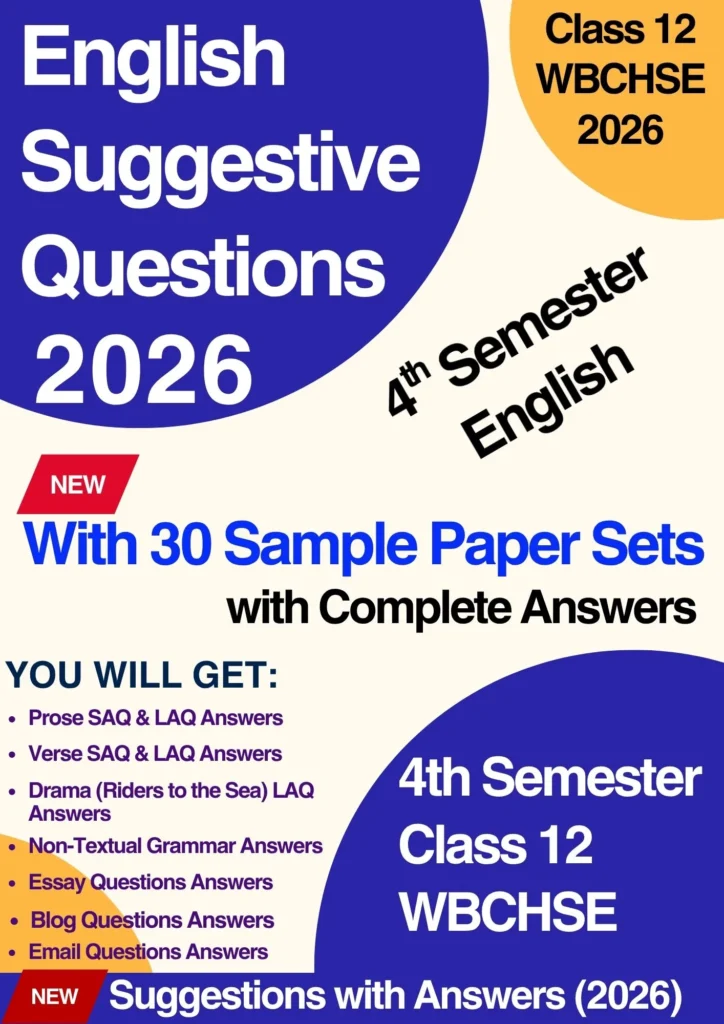
Get the complete Suggestions with Answers 2026 in one place! This PDF includes a wide range of SAQ and LAQ questions with answers from Prose, Poetry, Drama (Riders to the Sea), Non-Textual Grammar, and Writing Skills. It also features 30 Sample Question Paper Sets with Answers to help you prepare effectively and study with confidence.
6. What unusual event caught Alice’s attention while she was thinking about daisies? [Ans: 67]
7. How did the rabbit appear physically, and what did Alice hear it saying? [Ans: 42]
8. What made Alice start to her feet and feel curious? [Ans: 45]
9. What did Alice witness that prompted her to follow the rabbit? [Ans: 68]
10. Why did Alice go down the rabbit hole without thinking about getting out? [Ans: 1]
11. How is the rabbit-hole described in the story? [Ans: 46]
12. How did Alice feel when she started falling into the rabbit hole? [Ans: 3]
13. What did Alice notice during her fall? [Ans: 4]
14. Why was Alice unable to see what was below her while falling? [Ans: 69]
15. What did Alice find on the shelves while falling, and what was her reaction? [Ans: 70]
16. What did Alice wonder about while falling, and why did she speak aloud? [Ans: 71]
17. Why did Alice not get hurt from the fall through the rabbit hole? [Ans: 53]
18. Finally, she landed with a soft thud at the bottom — how did she feel upon landing? [Ans: 5]
19. Why did Alice encounter a hallway with many doors? [Ans: 6]
20. How did Alice feel about the tiny door she discovered? [Ans: 7]
SUGGESTION [LAQ] 6 Marks 120 words
1. Describe what happens when Alice falls down the rabbit hole. [Ans: 1]
2. What was special about the White Rabbit? Why did Alice follow it? (3+3 Marks) [Ans: 2]
3. What physical experiences and mental imaginations occupy Alice as she keeps falling down the rabbit hole? [Ans: 1 / 5 / 14 merged]
4. Why does the opening chapter emphasize Alice’s boredom and sleepiness before adventure begins? [Ans: 3]
5. How does Alice’s reaction to the White Rabbit change from her first sight to her second, thoughtful observation? (3+3 Marks) [Ans: 4]
6. What kinds of objects did Alice notice on the sides of the well, and what do they suggest? [Ans: 5]
7. How do Alice’s thoughts about geography and her school lessons reflect her limited knowledge? [Ans: 37 / 31 linked]
8. Despite discovering the golden key, why can’t Alice open the doors, and what does she do next? (3+3 Marks) [Ans: 6]
9. What does Alice see when she looks through the small door, and how does it affect her mood? [Ans: 7 / 33 related]
10. Why does Alice hesitate before drinking from the bottle labeled “Drink Me”? (4+2 Marks) [Ans: 8]
11. How does Alice’s shrinking body change her perspective of the world around her? [Ans: 9 / 20 linked]
12. How does Alice’s discovery of the cake labeled “Eat Me” show her practical reasoning? [Ans: 11]
13. In what way does Alice’s habit of talking to herself reflect the theme of identity in the story? [Ans: 13]
14. How does Alice’s imagination about Dinah the cat play a role during her fall? [Ans: 14]
15. How does Alice represent universal childhood in the story “Down the Rabbit-Hole”? [Ans: 15]
16. What is the symbolic significance of Alice’s fall into the rabbit-hole? [Ans: 16]
17. How does the strange atmosphere of the rabbit-hole world contrast with Alice’s ordinary reality? [Ans: 17]
18. How does Alice’s curiosity help her adjust to strange situations in Wonderland? [Ans: 22 / 19 combined]
19. How does Alice use her imagination to make sense of the strange things she encounters? [Ans: 19]
20. What emotions does Alice experience when she grows and shrinks? How do these experiences help her understand herself? (3+3 Marks) [Ans: 20]
4th Semester English Suggestion with Answers: Three Questions.
SUGGESTION [SAQs] 2 Marks 40 words
1. Who wrote the story “Three Questions”? Who was a ‘Tsar’? [Ans: 48, 19]
2. What questions arose in the mind of the Tsar? [Ans :1, 2, 3, 4]
3. Why did the Tsar want to have the answers to the three questions? [Ans: 22, 5]
4. What did the Tsar proclaim throughout his kingdom? [Ans: 24]
5. What answers did the learned men give to the first question of the Tsar? [Ans:10, 11, 26]
6. What answers did the learned men give for the second question asked by the Tsar? [Ans: 10, 26]
7. What answers did the learned men give to the third question of the Tsar?[Ans: 12, 13, 26]
8. Why was the Tsar dissatisfied with the answers of the scholars and learned men? [Ans: 21]
9. Why did the Tsar decide to consult the hermit? [Ans: 7, 5]
10. Why was the hermit famous? Where did he live? [Ans: 9, 8]
12. Why did the Tsar put on simple clothes before meeting the hermit? [Ans: 4]
13. How did the Tsar meet the hermit? [Ans: 28]
14. What did the Tsar see when he reached the hermit’s hut? [Ans: 17, 35]
15. Why did the hermit breathe heavily every time he stuck his spade into the ground? [Ans: 31]
SUGGESTIONS [LAQs ] 6 Marks 120 words
1. What were the three questions the Tsar wanted to get answers of? Why did he need the answers? Why was he not satisfied with the answers of the learned men? Whom did the Tsar finally decide to consult? (3 + 1 + 1 + 1) [Ans: 1]
2. “All the answers being different, the Tsar agreed with none of them.” What were the questions to which the Tsar got different answers? Whom did the Tsar decide to consult when he was not satisfied? Where did the person live whom the Tsar decided to consult? What was he famous for? (3 + 1 + 1 + 1) [Ans: 2]
3. “Here comes someone running.”—Who is the speaker? Who came running? What was the condition of the person who came running? How was the person taken care of? (1 + 1 + 2 + 2) [Ans: 16]
4. How was the wounded man revived and nursed? Why did he ask forgiveness of the Tsar? What did the Tsar do when he had gained the man for a friend? (2 + 2 + 2) [Ans: 25]5. Why did the bearded man become an enemy of the Tsar? What did the man swear and resolve to do? Why did he ask for forgiveness of the Tsar and what did he promise him? (1 + 2 + 3) [Ans: 5]
5. Why did the bearded man become an enemy of the Tsar? What did the man swear and resolve to do? Why did he ask for forgiveness of the Tsar and what did he promise him? (1 + 2 + 3) [Ans: 5]
6. What did the Tsar proclaim for the correct answers? Could the learned men satisfy him? What was the Tsar’s reaction to their answers? Why was he dissatisfied with the answers of the scholars and the learned men? (1 + 1 + 2 + 2) [Ans: 6]
7. What were the three questions proposed by the Tsar? How did he get the answers? What were the answers? (3 + 1 + 2) [Ans: 36]
8. What is the moral message embedded in the short story Three Questions? (6) [Ans: 14]
9. How did the enemy of the Tsar become a friend of the king in Leo Tolstoy’s Three Questions? (6) [Ans: 25]
10. What were the questions that had occurred to the Tsar? Why did he need correct answers to those questions? What did he do when he was not satisfied with the answers of the learned men? (3 + 1 + 2) [Ans: 1]
4th Semester English Suggestion with Answers: Hawk Roosting
SUGGESTION [SAQ] 2Marks in 40 words
1. Who wrote the poem Hawk Roosting? To which literary era did he belong? [Ans: 6]
OR, Who is the poet of Hawk Roosting? Mention his nationality. [Ans: 6]
2. Who is the speaker of the poem Hawk Roosting? What does it represent? [Ans: 3, 6]
3. Discuss the significance of the title Hawk Roosting. [Ans: 9]
OR, Why is the poem titled Hawk Roosting?
4. What is the meaning of the word “roosting”? Where and how does the hawk roost? [Ans: 10]
5. What is the structure of the poem? How does it help the flow of the poem? [Ans: 8]
6. “I sit in the top of the wood, my eyes closed.” — Who is the speaker? Why does he sit with his eyes closed? [Ans: 3, 4]
7. What does the position of the hawk on the top of the tree signify? [Ans: 1]
8. What does the phrase “no falsifying dream” mean in the poem? [Ans: 5, 14]
OR, “ in sleep rehearse perfect kills and eat.” — What does the hawk mean by this line?
9. “The air’s buoyancy and the sun’s rays” — How do they help the hawk? [Ans: 22, 18, 19]
10. “Now I hold Creation in my foot.” — What does the hawk mean by this line? [Ans: 26, 25]
11. “I kill where I please because it is all mine.” — Who says this? What does it reveal about his attitude? [Ans: 28, 29, 30]
SUGGESTION [LAQ] 6 Marks in 120 words
1. Discuss the significance of the title Hawk Roosting. [Ans: 10]
OR, Why is the poem entitled Hawk Roosting? (6 marks)
2. Write a short note on the central idea or main theme of the poem Hawk Roosting. [Ans: 12]
OR, What message does the poem convey about power and nature? (6 marks)
3. “It took the whole of Creation / To produce my foot… Now I hold Creation in my foot.” — What does the hawk mean by these lines? How does it reveal his arrogance and superiority? (3+3 = 6 marks) [Ans: 4]
4. “There is no sophistry in my body.” — How does this line reflect the hawk’s brutal frankness? (3)
OR,
What deeper idea does Hughes suggest through this statement? (3) (6 marks) [Ans: 2]
5. “I kill where I please because it is all mine.” — Explain how this line reflects the hawk’s pride and sense of ownership. (6 marks) [Ans: 5]
6. What does the hawk symbolize in the poem?
OR, How does the hawk represent human arrogance and domination? (6 marks) [Ans: 9]
7. Analyse Hawk Roosting as a dramatic monologue. [Ans: 8]
OR, How does Hughes’ choice of monologue help reveal the hawk’s personality and theme? (6 marks)
8. “No arguments assert my right: The sun is behind me.” – Explain the meaning of these lines. How can they be interpreted as a metaphor for dictatorship or absolute authority? (3+3 = 6 marks) [Ans: 7]
9. Bring out the allegorical significance of Hawk Roosting. [Ans: 1]
OR, How does the poem symbolize dictatorship and moral corruption of power? (6 marks)
10. “Nothing has changed since I began. My eye has permitted no change.” — Explain these lines. What does the hawk’s rejection of change signify? (3+3 = 6 marks) [Ans: 13]
4th Semester English Suggestion with Answers: Sonnet 73 (LXXII)
SUGGESTION [SAQ] 2 Marks in 40 Words
1. Who is addressed in Sonnet 73? [Ans: 2]
OR, To whom has Sonnet 73 been addressed? [Ans: 2]
OR, Who is ‘thou’ referred to in the poem? What does the repetition of ‘thou’ emphasize?
2. Who wrote Sonnet 73, and when was it first published? [Ans: 1]
3. What does Shakespeare mean by “That time of year”? [Ans: 18]
OR, What does the expression “That time of year” stand for?
OR, What time of the year has been referred to in the poem?
4. Which season is compared to the speaker’s life? [Ans: 8]
OR, Why is autumn chosen as the season for comparison? [Ans: 8]
OR, How is old age compared to the autumn season? [Ans: 8]
OR, “When yellow leaves, or none, or few, do hang”—What do the ‘yellow leaves’ symbolize?
6. Explain the image “Bare ruined choirs, where late the sweet birds sang.” [Ans: 9]
OR, What does the poet mean by ‘bare ruin’d choirs’? [Ans: 9]
OR, How did the choirs become ‘ruin’d’? Who are compared to ‘sweet birds’? [Ans: 9]
7. “In me thou seest the twilight of such day”—What does “twilight” symbolize? [Ans: 10]
OR, What does twilight suggest here? [Ans: 10]
8. “Which by and by black night doth take away”—What does ‘black night’ refer to? [Ans: 11]
OR, What does ‘black night’ symbolize? [Ans: 10]
OR, What does ‘which’ refer to? [Ans: 10]
9. What is meant by “Death’s second self”? [Ans: 12]
OR, Why is night called ‘Death’s second self’? [Ans: 12]
OR, What does the expression “that seals up all in rest” mean? [Ans: 12]
10. “In me thou seest the glowing of such fire”—What does ‘fire’ symbolize? [Ans: 21]
OR, What is consuming the speaker’s life force? [Ans: 21]
11. What does the poet mean by “Consumed with that which it was nourish’d by”? [Ans: 14]
OR, What consumes the fire and what nourishes it? [Ans: 14]
SUGGESTION [LAQ] 6 Marks in 120 Words
1. Analyze the title of Sonnet 73. [Ans: 1]
OR, Critically analyze Shakespeare’s Sonnet 73.
2. Give the substance of the poem. [Ans: 2]
OR, Write a short note on the central idea of Sonnet 73. [Ans: 16]
3. How does Shakespeare explore the themes of aging, mortality, and the ravages of time in Sonnet 73? [Ans: 4]
4. “That time of year thou mayst in me behold…” — Explain how the poet compares himself with autumn. [Ans: 19]
OR, What conceit does the poet establish in the first quatrain?
5. “In me thou seest the twilight of such day…” — How does the poet use the image of sunset to convey the theme of aging? [Ans: 20]
6. Discuss the various images drawn by Shakespeare in Sonnet 73. [Ans: 5]
OR, How does Shakespeare’s use of images enhance the beauty of the poem?
7. Bring out the significance of the concluding couplet in Sonnet 73. [Ans: 25]
OR, What message does the final couplet convey? [Ans: 25]
OR, “Consum’d with that which it was nourish’d by.” – Explain the meaning and significance of the line. [Ans: 25]
OR, “This thou perceiv’st, which makes thy love more strong.” – What does ‘this’ refer to? What makes the beloved’s love stronger? [Ans: 25]
8. How does the poet depict old age and mortality through nature’s imagery? [Ans: 26]
OR, Why has Shakespeare used nature as a metaphor for aging?
9. What does ‘fire’ represent in Sonnet 73? Explain how it symbolizes the speaker’s life and passion. [Ans: 27]
10. Discuss the use of symbols in Sonnet 73. [Ans: 36]
OR, Comment on Shakespeare’s symbolic treatment of life and death. [Ans: 8]
4th Semester English Suggestion with Answers: The Greenhouse Effect
SUGGESTIONS [SAQs] 2 Marks in 40 Words
1. Who wrote the poem The Greenhouse Effect and when was it published? [Ans: 3]
OR What kind of a poem is The Greenhouse Effect written by Carl Dennis? [Ans: 2]
2. What is the greenhouse effect? [Ans: 5]
OR Why is the greenhouse effect a pressing concern?
3. What is the central theme of the poem? [Ans: 60]
OR How does the poem use the metaphor of a ‘greenhouse’ to explore climate change? [Ans: 60]
4. “The gradual warming trend will likely go on” – What does ‘gradual warming trend’ mean? Why does the poet think it will continue? [Ans: 10]
5. What is meant by ‘grain belts’? [Ans: 8]
OR Why do the grain belts begin to slide closer to the poles?
6. Why and how will the Plains States be abandoned as ‘giant dust bowls’? [Ans: 9]
OR Describe the fate of the Plains States in the poem.
7. What will happen to Greenland and Antarctica? [Ans: 13]
OR, How will Greenland and Antarctica join the ‘new Great Powers’?
8. What does ‘Great Powers’ refer to?
OR, Which regions are predicted to rise in power due to global warming? [Ans: 11]
9. How will life be different in the future according to the poem? [Ans: 18]
OR, What changes can be expected in the working pattern due to global warming?
10. What will happen to the suburbs and the cities? [Ans: 18]
OR How does the poem represent suburban and city life in the future?
11. Why will people have to go to their workplaces by walking or on trolleys? [Ans: 23]
OR Why will the people be too poor to own cars?
12. Why will streets be lined with ‘practical nut trees’? [Ans: 25]
OR Why has the poet focused on vegetable cultivation? [Ans: 24]
SUGGESTIONS [LAQs] 6 Marks in 120 Words
1. Analyze the title of the poem The Greenhouse Effect. [Ans: 50]
OR, What is your opinion about the title of the poem The Greenhouse Effect by Carl Dennis?
2. Give the substance/summary of the poem The Greenhouse Effect. [Ans: 1]
OR, Write a brief summary of the poem The Greenhouse Effect.
3. Write a short note on the central idea of The Greenhouse Effect. [Ans: 36]
OR, Critically analyze Carl Dennis’s The Greenhouse Effect.
4. Mention any three major themes in Carl Dennis’s poem The Greenhouse Effect. [Ans: 1]
OR, Comment on the theme of Nature’s resilience in the poem.
5. Comment on the theme of economic disparity in The Greenhouse Effect. [Ans: 23]
OR, What is the poet’s aim in writing the poem?
6. How does The Greenhouse Effect function as speculative poetry?
7. How does the poem The Greenhouse Effect critique human complacency? [Ans: 37]
OR, How does the poem balance a sense of loss with a sense of adaptation?
8. What events will supposedly take place according to the poet due to the greenhouse effect?
OR, How does the poem The Greenhouse Effect depict the consequences of climate change? [Ans: 2]
9. “The gradual warming trend will likely go on / And the grain belts begin to slide closer to the poles.”
Explain the significance of this shift in the poem. [Ans: 22]
10. How does Carl Dennis describe the impact of climate change on agriculture in The Greenhouse Effect? [Ans: 22]
11. How does the poem The Greenhouse Effect describe changes in urban and suburban life? [Ans: 10]
OR, How does the poem depict the transformation of suburban life?
4th Semester English Suggestion with Answers: Riders to the Sea
SUGGESTIONS [SAQs] 5 Marks in 120 Words
1. Analyze the title of the play Riders to the Sea. [Ans: 1]
2. Justify Riders to the Sea as a one-act play. [Ans: 2]
3. Evaluate the ending of the play as both tragic and reconciliatory. [Ans: 3]
4. Discuss Maurya’s character as a symbol of motherhood, suffering, and resilience. [Ans: 4]
5. Discuss how Maurya’s grief and acceptance of loss express the theme of human vulnerability against fate. [Ans: 5]
6. Discuss Riders to the Sea as a tragedy. [Ans: 6]
7. Discuss the symbolic importance of the sea in Riders to the Sea. [Ans: 7]
8. The sea is not merely a background; it is a living character – Discuss. [Ans: 7]
9. Examine the role of fate and inevitability in shaping the tragic events of the play. [Ans: 8]
10. How does Synge depict the relationship between life and death in Riders to the Sea? [Ans: 10]
11. How does Riders to the Sea attain universal significance? [Ans: 11]
12. Explain the supernatural elements used by Synge in the play. [Ans: 12]
13. How does the play reflect the harsh reality of life faced by the Aran Islanders? [Ans: 13]
14. Why is Riders to the Sea called a poetic drama? [Ans: 17]
15. What are the central themes of Riders to the Sea? [Ans: 17]16. “They’re all gone now, and there isn’t anything more the sea can do to me.” – Explain. [Ans: 22]
4th Semester English Suggestion with Answers: Non-Textual Grammar [5 Marks]
Set 1
6. Do as directed: (Non-Textual Grammar)
(i) Shubham tried his best to convince them. They refused to believe his words. They thought he was lying.
[Join into a Complex sentence] (2)
OR
The faithful dog began to keep guard over the valuables which the master left behind him in a hurry. [Split into Uni-clausal sentences] (2)
(ii) Stamp collection is a popular hobby ___ the world. ___ the youngsters as well as the adults all. [Fill in the blanks with appropriate Articles and/or Prepositions] (½ + ½ = 1)
(iii) Sayan greeted Sakshi and wished her good morning. [Change the Narration] (1)
(iv) Until he was eating, the dog jumped on his lap. [Correct the Error(s) in the sentence, if any] (1)
= [Ans: SET 1]
Set 2
6. Do as directed: (Non-Textual Grammar)
(i) The weather was bad. The team decided to continue the match. They had practised hard. They didn’t want to disappoint their fans. [Join into a Complex sentence] (2)
OR
As we reached the heritage building with the intention of entering it, we found the gates closed. [Split into Uni-clausal sentences] (2)
(ii) The cat jumped ___ the wall and hid ___ the bushes ___ fear. [Fill in the blank with appropriate Preposition] (1)
(iii) Kiran said, “My brother is allergic to pineapples.” [Change the Narration] (1)
(iv) We should not laugh of the lame person. [Correct the Error(s) in the sentence, if any] (1)
= [Ans: SET 2]
Set 3
6. Do as directed: (Non-Textual Grammar)
(i) Nilesh Sarkar has written an autobiography. In it, he tells the story of his life. Part of his life was spent in jail of his own country. [Join into a Complex sentence] (2)
OR
Our teacher taught us that it is the duty of every man to love his neighbours and help them to the best of his power. [Split into Uni-clausal sentences] (2)
(ii) I don’t want ___ go outside; I don’t want to pay ___ anyone’s expectations. I have to finish my homework. [Fill in the blanks using appropriate Articles and/or Prepositions] (½ × 2 = 1)
(iii) Kartick said to Sudha, “I am going for shopping. Can I get you something?” [Change the mode of Narration] (1)
(iv) I wished I had learnt dancing when I was young. [Correct the Error(s) in the sentence, if any] (1)
= [Ans: SET 3]
Set 4
6. Do as directed: (Non-Textual Grammar)
(i) My sisters are always eager to listen to stories. They love to listen the fairy tales. They are very curious by nature. [Join into a Complex sentence] (2)
OR
Seeing that his end was near, Hamlet suddenly stabbed his uncle with the poisoned sword and avenged at last the murder of his father. [Split into Uni-clausal sentences] (2)
(ii) Since the mid 20th century, it has been the focus of ___ urban legend that many aircrafts, ships and people have disappeared ___ the Bermuda Triangle ___ mysterious circumstances. [Fill in the blanks using appropriate Articles and/or Prepositions] (1 × 3 = 3)
= [Ans: SET 4]
Set 5
6. Do as directed: (Non-Textual Grammar)
(i) They wanted to go on vacation. They saved money for months. Unexpected expenses forced them to postpone their trip. [Join into a Compound sentence] (2)
OR
A yellow beam of sunlight, filtering through the muslin curtains, slanted onto the table. [Split into Uni-clausal sentences] (2)
(ii) Distribute the chocolates ___ the students. [Fill in the blank with appropriate Preposition] (1)
(iii) I said to my sister, “Let us go to a hill station for a change.” [Change the Narration] (1)
(iv) Each of the girls have submitted their notebooks. [Correct the Error(s) in the sentence, if any] (1)
= [Ans: SET 5]
Set 6
6. Do as directed: (Non-Textual Grammar)
(i) There was a painter. His name was Abhirup. He could make beautiful portraits. Everyone liked him because of that. [Join into a Simple sentence] (2)
OR
Among the many boys present there, only he had the courage to agree to the proposal of going out in search of the missing child. [Split into Uni-clausal sentences] (2)
(ii) We sat ___ the fire, and talked ___ our journeys together. [Fill in the blanks using appropriate Articles and/or Prepositions] (½ × 2 = 1)
(iii) Dishonestful behaviour can break trust in relationships. [Correct the Error(s) in the sentence, if any] (1)
(iv) The monk said, “God help us all.” [Change the mode of Narration] (1)
= [Ans: SET 6]
Set 7
6. Do as directed: (Non-Textual Grammar)
(i) I visited the garden. There were some beautiful rose-trees. The trees were full of bloom. Those flowers were red and white in colour. [Join into a Complex sentence] (2)
OR
Afraid of facing the danger that awaited him there, he left the place in the darkness of the night and escaped into a village not far off. [Split into Uni-clausal sentences] (2)
(ii) The sun rose slowly ___ the rooftops, ___ the quiet town, casting ___ golden light. [Fill in the blanks using appropriate Articles and/or Prepositions] (1 × 3 = 3)
= [Ans: SET 7]
Set 8
6. Do as directed: (Non-Textual Grammar)
(i) The bell rang. The students rushed out of the classroom. They were eager to enjoy their break. They chatted excitedly about their weekend plans. [Join into a Complex sentence] (2)
OR
When he realised that he had made a mistake, he apologised to the authority. [Split into Uni-clausal sentences] (2)
(ii) During the COVID-19 pandemic, technology played ____ crucial role ____ continuing education worldwide. [Fill in the blank with an appropriate Preposition] (1)
(iii) He did waiting for a train at an empty junction. [Correct the Error(s) in the sentence, if any] (1)
(iv) Jessy said to Harley, “May I borrow your book?” [Change the Narration] (1)
= [Ans: SET 8]
Set 9
6. Do as directed: (Non-Textual Grammar)
(a) He is blind to his own faults. He is respectable. I know the man. He is not popular among his colleagues. [Turn into a Complex sentence / Synthesis of sentences] (2)
OR
(b) While I was having my dinner, I came across certain news on the TV, and it made me feel quite uncomfortable though I knew that everything in this world is essentially ephemeral. [Split into Uni-clausal sentences] (2)
7. Fill in the blanks with appropriate Articles and/or Prepositions: (1 × 3 = 3)
When she got ___ her door, she dragged ___ boy inside, down ___ hall.
= [Ans: SET 9]
Set 10
6. Do as directed: (Non-Textual Grammar)
(a) The team practised hard all season. They were confident of winning the championship. They lost the final match by one point. They were heartbroken but proud of their effort. [Turn into a Compound sentence] (2)
OR
(b) To improve his health and energy levels, Mark started jogging every morning and also began eating more vegetables. [Split into Uni-clausal sentences] (2)
7. Fill in the blanks with appropriate Articles and/or Prepositions: (1 × 3 = 3)
The new plastic material developed ___ Japanese scientists dissolves ___ seawater in just ___ few hours, leaving no residue behind.
= [Ans: SET 10]
4th Semester English Suggestion with Answers: Essay Writing [10 Marks]
1. Write an essay on ‘Discipline in Student Life’ using the following points in about 150 words. (10)
[Points: Key to success – Helps study & time – Builds respect – Without it failure – Life foundation] = [Ans: 21]
2. Write an essay on ‘Role of Teachers’ using the following points in about 150 words. (10)
[Points: Guide youth – Spread knowledge & values – Inspire patriotism – Nation strength in education – Teachers nation builders] = [Ans: 22]
3. Write an essay on ‘Value of Hard Work’ using the following points in about 150 words. (10)
[Points: No success without effort – Luck secondary – Inspires confidence – Builds character – Hard work always pays] = [Ans: 53]
4. Write an essay on ‘Moral Education’ using the following points in about 150 words. (10)
[Points: Teaches values & honesty – Prevents crime – Builds good citizens – Peaceful society – Foundation of progress] = [Ans: 27]
5. Write an essay on ‘Science – Blessing or Curse’ using the following points in about 150 words. (10)
[Points: Comfort & progress – Misuse harmful – Medicine/transport blessing – Weapons curse – Proper use blessing] = [Ans: 31]
6. Write an essay on ‘Women Empowerment’ using the following points in about 150 words. (10)
[Points: Equal rights – Education & jobs – Laws protect women – Political participation – Progress with equality] = [Ans: 43]
7. Write an essay on ‘Unity in Diversity’ using the following points in about 150 words. (10)
[Points: India’s strength – Many languages/religions – Still united – Promotes peace – Example for world] = [Ans: 46]
8. Write an essay on ‘Role of Youth in Nation-Building’ using the following points in about 150 words. (10)
[Points: Youth = backbone – Energy & ideas – Education empowers – Role in politics/social work – Future of nation]
= [Ans: 59]
9. Write an essay on ‘Importance of English’ using the following points in about 150 words. (10)
[Points: Global language – Link between cultures – Needed for jobs – Internet & science in English – Opens opportunities] = [Ans: 52]
10. Write an essay on ‘Digital India’ using the following points in about 150 words. (10)
[Points: Govt. initiative – Technology for governance – Online services – Transparency – Benefits for students & rural people] = [Ans: 56]
4th Semester English Suggestion with Answers: Blog Writing [5 Marks]
1. Write a blog on your visit to the Jagannath Temple in Digha.
[Points: Construction began in 2022 – inaugurated on April 30, 2025 – replica of Jagannath temple, Puri – made of sandstone – idols of Jagannath, Subhadra, and Balaram – your experience and feelings] = [Ans: 1]
2. Write a blog on ‘Value of Time’.
[Points: Time waits for none – wasting time leads to regret – need of time management – conclusion] = [Ans: 27]
3. Write a blog on the importance of yoga for mental health.
[Points: Natural approach to mental well-being – connects body and mind – reduces stress and anxiety – boosts concentration and sleep quality – promotes positivity] = [Ans: 28]
4. Write a blog on overcoming the fear of failure.
[Points: Failure is not the end – another chance to learn – stay positive, believe in yourself – conclusion] = [Ans:5]
5. Write a blog on how to overcome procrastination.
[Points: Habit of delaying tasks – leads to stress – make a to-do list – eliminate distractions – take breaks – reward yourself – conclusion] = [Ans: 6]
6. Write a blog on the importance of sports in shaping our lives.
[Points: Introduction – teaches life lessons – discipline, teamwork, resilience – builds confidence and leadership – shapes character – conclusion] = [Ans: 29]
7. Write a blog on how setting goals leads to success.
[Points: Clear goals help achieve success – help to stay focused and motivated – conclusion] = [Ans: 15]
8. Write a blog on the importance of skill-based education in today’s world.
[Points: Practical skills solve real problems – job readiness – skills like coding and problem-solving – foster confidence and innovation – conclusion]
9. Write a blog on the ‘Vocal for Local’ movement – an initiative for promoting local businesses.
[Points: Movement to support local business initiated in India in 2020 – to make the country self-sufficient and stronger – conclusion] = [Ans: 16]
10. Write a blog on eco-tourism.
[Points: An eco-friendly way of traveling – supports local communities – conserves nature – tips for practicing eco-tourism] = [Ans: 17]
4th Semester English Suggestion with Answers: Email Writing [5 Marks]
Informal Emails (Personal Emails) Suggestions:
1. Write an email to your friend thanking him/her for the birthday gift. = [Ans: Informal 2]
2. Write an email to your friend sharing your experience of a recent family trip. = [Ans: Informal 14]
3. Write an email to your friend who is feeling anxious as he/she is appearing for Higher Secondary Examination. = [Ans: Informal 12]
4. Write an email to your mother about your daily life in a hostel. = [Ans: Informal 17]
5. Write an email to your sister congratulating her on her first job. = [Ans: Informal 27]
6. Write an email to your brother advising him to maintain a healthy lifestyle before his Madhyamik Examination. = [Ans: Informal 16]
7. Write an email to your friend about how you celebrated your birthday this year in an orphanage. = [Ans: Informal 26]
8. Write an email to your father seeking advice after your purse was stolen. = [Ans: Informal 28]
9. Write an email to your friend sharing your thoughts on the power of showing humanity and kindness. = [Ans: Informal 32]
10. Write an email to your younger brother/sister informing him/her about the pros and cons of using mobile phones.